Did you know?
In the United States a coffee creamer may be sold as nondairy and still contain a milk protein. The labelling rules only ask the maker to add words such as “a milk derivative” in the ingredients list. A kosher symbol with a D beside it tells you the same thing at a glance.
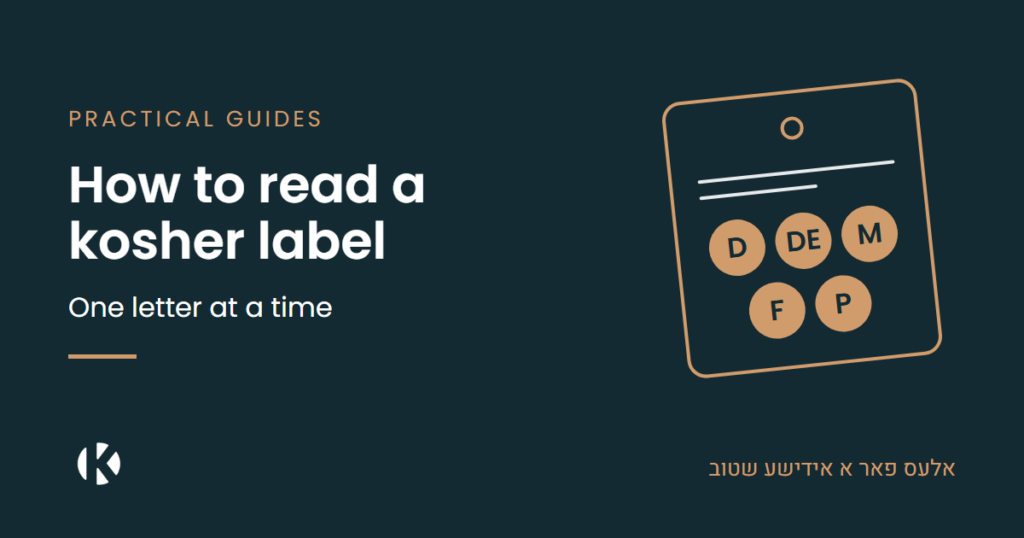
Pick up a jar, a packet of biscuits or a bar of chocolate and you will often find a tiny mark near the barcode, with a letter or a word beside it. To many shoppers it is a mystery. To anyone who keeps kosher it is a short message from the people who checked the factory. This practical guide explains the most common letters, in the words of the certifying agencies themselves.
A kosher symbol, often called a hechsher, is the registered mark of the agency that supervises the product. Earlier articles in our Behind the symbol series told the stories of many of them, from London and Manchester to New York, Antwerp and Jerusalem. Because each mark belongs to one agency, it tells you who stands behind the food.
A plain letter K is different. OK Kosher Certification points out that plain letters of the alphabet cannot be registered as a trademark, so in some places anyone may print one. A bare K therefore does not tell you which rabbi or agency, if any, supervised the product. If that is all the label shows, ask the maker who certifies it.
The letter you will meet most often is D. The Orthodox Union, whose OU mark is one of the most widely used in the world, requires OU-D on every certified product that contains dairy ingredients. Its guide to the symbols adds that OU-D can also appear on a product with no milk in the recipe that was made on equipment also used for dairy foods.
This is where the kosher label is often more exact than the front of the pack. American food law allows the word nondairy on a creamer made with sodium caseinate, a protein that comes from milk, as long as the ingredients list says so in brackets. The D next to the kosher symbol says it without the brackets. One caution matters here. A kosher symbol is not an allergy statement, so anyone with a milk allergy should always read the full ingredients and allergen panel.
Some agencies separate the two cases. OK Kosher describes its DE mark as an essentially pareve product that was made on dairy equipment after the lines were thoroughly cleaned. The OU lists OU-DE in the same way, as a product made on dairy equipment. What that means at your own table, for instance after a meat meal, is a question for your own rabbi.
Pareve, also spelled parev or parve, describes food that is neither meat nor dairy, such as fruit, vegetables, eggs, grains and fish. The OU states that a product bearing its symbol without a D can generally be assumed to be pareve, and that such a product contains neither dairy nor meat and was not made on dairy equipment. Many labels simply print the word Pareve beside the symbol.
An M or the word Meat beside the symbol marks food that is, or contains, kosher meat or poultry, or was made with a meat derivative. Glatt, in the words of OK Kosher, represents an extra level of quality control for kosher meat or poultry.
Fish is pareve, yet the kosher tradition does not eat fish and meat together. For that reason some labels carry an F or the word Fish. A classic example is Worcestershire sauce, which is traditionally made with anchovies. The OU explains that it labels a product OU-F when the fish makes up more than one part in 60 of the recipe.
Here is the letter that catches people out. A P beside a kosher symbol stands for Passover. OK Kosher says it plainly. Its P denotes Passover certification, not pareve. The OU uses OU-P for products that are kosher for Passover.
Some Passover products contain kitniyot, such as rice, corn or pulses, which many Sephardi families eat on Passover and most Ashkenazi families do not. OK Kosher prints the word Kitniyot next to or under the P on those products, so check for it if your family custom avoids them.
Three more terms appear on dairy and baked goods. Cholov Yisroel, sometimes shortened to CY, marks milk that was supervised from the milking onwards, an added level that many communities keep. Pas Yisroel, or PY, marks bread and baked goods made to a stricter baking standard. Mehadrin is a Hebrew word for an enhanced level of supervision. Our article on the Rabbanut explains how it is used in Israel.
Not every kosher product carries a letter. In Britain the London Beth Din runs a product search called Is it Kosher, which sorts products into Parev, Dairy, Meaty and Dairy Equipment. Its own notes say that the data applies only to products made for the UK market and that a product not found there should not be assumed kosher.
In Israel the label speaks in full Hebrew words. You will see kosher, parve, dairy or meat written out, together with the name of the local rabbinate or the badatz that supervised the food. Imported dairy products often carry a line saying that they are for those who eat milk powder that is not Cholov Yisroel.
Next time you browse the food sellers on The Kosher Shop, look for the names and letters you now know.
Judaica, gifts, food and wine from businesses we know personally.
We use essential cookies to keep the site working. With your permission, we'd also like to use analytics cookies to understand how the site is used, so we can improve it. You can change your choice at any time.